Table of Contents
ToggleThe tiny house movement has found a particularly appealing niche in Florida’s coastal communities, where scaled-down living meets year-round outdoor weather and relaxed beachside culture. Siesta Key and similar Gulf Coast areas offer a compelling backdrop for downsized homes, think ocean breezes replacing square footage, outdoor showers instead of sprawling bathrooms, and porches that function as additional rooms. But building or buying a tiny house in these zones isn’t as simple as parking a trailer near the sand. Between hurricane codes, flood elevation requirements, and local zoning restrictions, prospective tiny house dwellers need to navigate real logistical hurdles before they can embrace that simplified coastal lifestyle.
Key Takeaways
- Tiny house siesta living in Florida’s Gulf Coast requires hurricane-resistant materials, elevated foundations to meet FEMA flood elevation requirements, and compliance with strict local zoning codes that often mandate 750–1,000 square feet for primary dwellings.
- Design prioritizes outdoor living—including covered decks, outdoor showers, and weather-resistant PVC decking—to maximize usable space and embrace year-round coastal weather without expanding interior square footage.
- Building a DIY tiny house in Siesta Key costs $35,500–$55,500 (plus labor), while turnkey units run $60,000–$120,000 before site preparation, land, and permits.
- Tiny houses on wheels occupy a legal gray area; many jurisdictions treat them as RVs limited to 180 days per year unless parked in designated RV communities, making permanent residence challenging without zoning variances.
- Living in 200–400 square feet delivers lifestyle benefits: simplified 30-minute cleaning cycles, utility costs under $1,500 annually, and a forced shift toward outdoor, experiences-focused living that aligns with Siesta Key’s beach culture.
- Accessory dwelling unit (ADU) regulations offer a legal pathway for tiny houses in Sarasota County, allowing structures up to 600 square feet or 40% of the primary dwelling footprint, provided owner-occupancy and setback requirements are met.
What Makes Tiny House Siesta Living Unique?
Tiny house living in Siesta Key and surrounding Gulf Coast communities differs from inland or mountain tiny house setups in several critical ways. The coastal environment demands corrosion-resistant fasteners (stainless steel or hot-dipped galvanized), impact-rated windows and doors to meet Florida Building Code hurricane provisions, and foundation systems that account for flood zones.
Most of Siesta Key sits in FEMA flood zones, meaning any permanent structure, including tiny houses on foundations, must meet base flood elevation (BFE) requirements. That typically translates to pier-and-beam or elevated post foundations, adding 3–8 feet of vertical clearance beneath the living floor. Tiny houses on wheels (THOWs) occupy a legal gray area: if they remain towable and unoccupied for more than 180 consecutive days, some jurisdictions treat them as recreational vehicles rather than dwellings. Always confirm local AHJ (authority having jurisdiction) rules before purchasing land or a unit.
The climate also shifts material choices. Pressure-treated southern yellow pine (rated for ground contact) works for framing members near grade, but exterior siding benefits from fiber cement, PVC trim, or marine-grade plywood rather than standard OSB sheathing, which delaminates in high humidity. Ventilation becomes non-negotiable: without adequate soffit-to-ridge airflow and a continuous ridge vent, attic spaces in tiny homes can hit 140°F in summer, warping framing and cooking any occupants in a lofted bedroom.
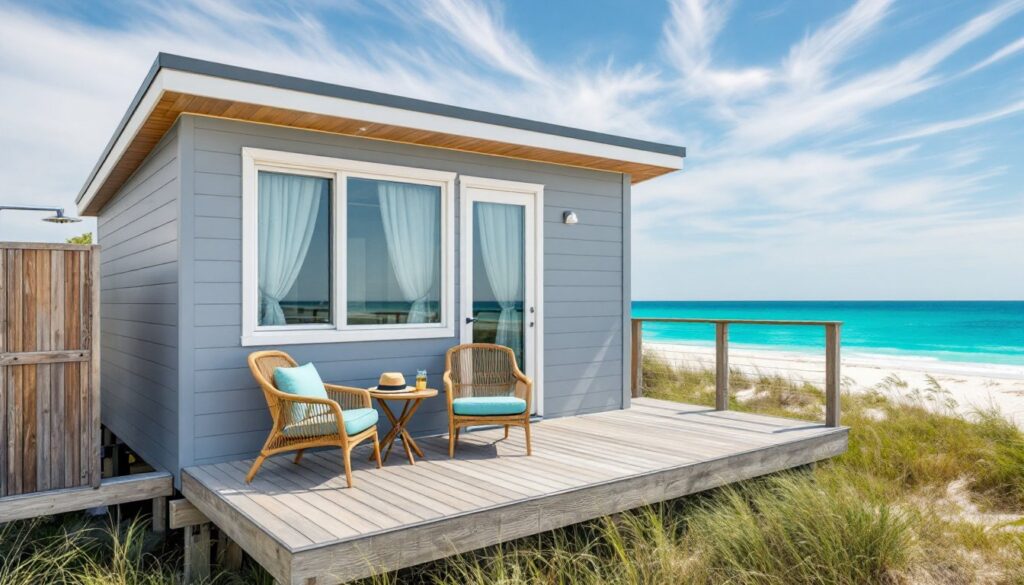
Another distinguishing factor is the culture of outdoor living. Tiny house siesta designs lean heavily on porches, decks, and outdoor kitchens to extend usable square footage without adding conditioned interior space. A 240-square-foot shell feels significantly larger when paired with a 120-square-foot covered deck and an outdoor shower, both of which are practical year-round in this climate.
Design Essentials for Your Siesta-Inspired Tiny Home
Designing a tiny house for a coastal, relaxation-focused lifestyle requires prioritizing flow, natural ventilation, and seamless indoor-outdoor transitions. The goal isn’t just to shrink a conventional house, it’s to rethink how space functions when you spend half your waking hours outside.
Maximizing Outdoor Living Spaces
In Siesta-style tiny house design, the porch or deck isn’t an afterthought, it’s a primary living zone. Budget at least 100–150 square feet for a covered deck with a roof overhang of 3–4 feet to block midday sun and rain. Use 5/4×6 PVC decking or ipe if budget allows: both resist mold, won’t splinter barefoot, and handle saltwater exposure without constant maintenance.
Install a outdoor ceiling fan (wet-rated, minimum 52-inch diameter) to keep air moving during humid evenings. Run electrical during framing, retrofitting is a pain. Consider an outdoor sink or prep counter plumbed with PEX: it’ll get more use than an indoor kitchen island. For privacy without blocking breeze, use lattice panels, bamboo screens, or horizontal cable railing rather than solid walls.
An outdoor shower is almost mandatory. Frame a simple 3×3-foot enclosure with pressure-treated 2×4s, clad it in corrugated metal or cedar slats, and install a frost-free sillcock or a tankless propane water heater if you want warm rinses. Concrete paver base with 3/4-inch gravel underneath handles drainage: skip the shower pan, this isn’t an indoor bathroom.
Interior Layout Strategies for Relaxation and Flow
Inside, prioritize cross-ventilation over square footage. Position operable windows on opposite walls to create airflow paths. Casement or awning windows work better than sliders in coastal wind: they seal tighter and can stay open during light rain. If you’re designing a lofted bedroom, add a gable-end window or transom above the loft to vent hot air, sleeping in a 95°F loft kills the siesta vibe fast.
Keep the main floor open. A combined kitchen-living area of 120–150 square feet feels breathable if you avoid interior partition walls. Use a kitchen peninsula (30 inches deep, 42 inches tall) to define the cooking zone without blocking sightlines. Butcher block countertops age well and can be sanded and refinished: laminate and tile both crack under road vibration if you’re building a THOW.
Storage should be built-in and dual-purpose. A window seat with lift-top storage, stairs with pull-out drawers (each tread = 1 drawer), and under-bed platform storage all maximize volume without adding furniture. For relaxation-focused layouts, resist the urge to cram in a dining table, most tiny house siesta dwellers eat on the deck or use a fold-down wall-mount table.
Lighting matters. Use LED strip lights with dimmer switches (12V DC if off-grid) under cabinets and along loft edges. Avoid overhead cans in a low-ceiling space: they create harsh shadows and make rooms feel smaller. For a laid-back aesthetic, think about small space living ideas that translate well to coastal minimalism, natural textures, light colors, and minimal clutter.
Zoning and Legal Considerations in Siesta Key and Surrounding Areas
Zoning is where most tiny house projects in Siesta Key hit a wall, literally. Sarasota County, which governs Siesta Key, has minimum dwelling size requirements that vary by zoning district. In most residential zones, that minimum is 750–1,000 square feet for a primary dwelling, effectively disqualifying tiny houses under 400 square feet unless classified as accessory dwelling units (ADUs).
ADU rules allow smaller structures on parcels with existing primary homes, but Siesta Key’s ADU ordinances cap size at 600 square feet or 40% of the primary dwelling’s footprint (whichever is less) and often require separate utility meters, setbacks of 10+ feet from property lines, and owner-occupancy of either the primary or accessory unit. Not all zones permit ADUs: confirm with Sarasota County Development Services before purchasing property.
For tiny houses on wheels, the legal path is murkier. If the unit remains titled as an RV and parked in an RV park or campground, it’s typically allowed for up to 180 days per calendar year under recreational vehicle ordinances. Parking a THOW on private residential land for habitation longer than that timeframe usually violates zoning codes unless the property is zoned for RV use or you obtain a variance, an expensive and uncertain process.
Building permits are required for any structure with a permanent foundation, including tiny houses. Expect plan review to check for compliance with the Florida Building Code (7th edition as of 2023), which includes wind load calculations (140+ mph in coastal zones), flood elevation documentation, and tie-down specifications if you’re using helical piers or slab-on-grade. If you’re wiring for 120/240V service, you’ll need an electrical permit and a licensed electrician to sign off.
One workaround gaining traction: buying into a tiny house community or co-housing development where zoning and utilities are already sorted. A handful of these exist within 30 minutes of Siesta Key, offering individual lots with shared amenities and clear legal standing. The trade-off is less autonomy and potentially higher land lease costs, but you skip the zoning fight entirely.
Cost Breakdown: Building or Buying a Tiny House in Siesta
Costs for tiny house siesta key projects vary widely depending on whether you build, buy a turnkey unit, or purchase a used shell and finish it yourself. Here’s a realistic breakdown as of 2026, factoring in Florida’s coastal location and current material prices.
Buying a Turnkey Tiny House:
A completed tiny house (200–400 square feet) from a reputable builder runs $60,000–$120,000, not including land or site prep. Units designed for hurricane zones with impact windows, elevated foundations, and corrosion-resistant materials sit at the higher end. Expect an additional $15,000–$30,000 for site work: grading, pier foundation installation, septic or sewer hookup, electric service trench, and water line.
Building from Scratch:
DIY builds can shave 30–40% off turnkey pricing if you have framing and finish carpentry skills. A 300-square-foot tiny house on a trailer frame costs roughly:
- Trailer: $5,000–$8,000 (dual-axle, 24-foot, rated for 10,000+ lbs)
- Framing lumber (2×4 studs, 2×6 floor joists, 2×8 rafters): $3,000–$4,500
- Sheathing, siding, roofing (Zip System, fiber cement, standing seam metal): $6,000–$9,000
- Windows and exterior door (impact-rated): $4,000–$7,000
- Insulation (closed-cell spray foam, R-21 walls, R-30 roof): $2,500–$4,000
- Electrical and plumbing rough-in (DIY or sub out): $3,000–$5,000
- Interior finishes (drywall or shiplap, flooring, cabinets, fixtures): $8,000–$12,000
- Appliances and mechanicals (mini-split, tankless water heater, composting toilet): $4,000–$6,000
Total DIY cost: $35,500–$55,500 plus your labor. Add 20% contingency for mistakes, shipping fees to Florida, and tools you don’t own.
Land Costs:
Buildable lots near Siesta Key that allow tiny houses or ADUs start around $80,000–$150,000 for 0.25–0.5 acres, depending on flood zone and proximity to the beach. If you’re going the RV park route, monthly lot fees run $600–$1,200, utilities included.
Permitting and Inspections:
Budget $1,500–$3,000 for building permits, plan review, and inspections. If you need a septic system (not municipal sewer), add $8,000–$12,000 for a standard gravity system: aerobic treatment units (required in some high water table areas) cost $12,000–$18,000.
For budget home renovation stories and cost-saving strategies, consider phased builds, shell first, finishes later, and sourcing reclaimed materials from Habitat for Humanity ReStores or salvage yards in Sarasota.
Lifestyle Benefits of Tiny House Living in a Coastal Community
The appeal of tiny house siesta living goes beyond cost savings. For many, it’s about recalibrating priorities, less time maintaining a house, more time outdoors, and a built-in excuse to declutter and simplify.
Simplified Maintenance:
A 300-square-foot house takes about 30 minutes to deep-clean. Exterior maintenance, power-washing siding, inspecting roof fasteners post-storm, resealing deck boards, might total 8–10 hours per year. Compare that to a 2,000-square-foot home where gutter cleaning alone eats a weekend.
Lower Utility Costs:
A well-insulated tiny house with a 9,000 BTU mini-split uses 600–900 kWh per month in Florida summer heat, translating to roughly $75–$110 in electricity (at $0.125/kWh). Propane for a tankless water heater and cooktop runs another $20–$30/month. Total annual utilities: under $1,500.
Outdoor-Centric Lifestyle:
Living in 200–400 square feet forces you outside. Morning coffee on the deck, outdoor showers, beach walks instead of TV binges, it’s a lifestyle shift that aligns with Siesta Key’s culture. The lack of space for excess belongings means you keep what matters: a couple of paddleboards, a bike, a hammock.
Community and Flexibility:
Tiny house owners in coastal areas often form tight-knit communities, sharing tools, skills, and hurricane prep strategies. If you’re on wheels, you’ve got geographic flexibility, spend hurricane season inland, return for winter.
The trade-offs are real: limited storage, challenging resale market, and the need to be ruthlessly organized. But for those who value experiences over square footage, tiny house siesta living in a place like Siesta Key delivers a high quality of life with a low footprint, both environmental and financial.