Table of Contents
ToggleTiny houses have shifted from novelty to viable housing option over the past decade. What started as a niche movement has evolved into a practical solution for first-time buyers, retirees, and anyone looking to downsize without sacrificing quality of life. The good news? You don’t need to hire an architect or drop thousands on blueprints to get started. Free tiny house plans are widely available online, offering complete schematics, material lists, and construction details at zero cost. This guide walks through where to find them, what to expect in the documentation, and how to navigate the legal and practical considerations before breaking ground.
Key Takeaways
- Free tiny house plans are available from reputable sources like Ana White and Tiny House Design, offering complete schematics, material lists, and construction details without cost.
- Tiny house living reduces construction costs to $20,000–$40,000 (vs. six figures for traditional homes) and cuts utility expenses by 60–80%, making homeownership accessible for first-time buyers and those downsizing.
- Quality free tiny house plans should include floor plans, elevations, cross-sections, and material lists, but often lack engineered stamps, electrical schematics, plumbing diagrams, and foundation details requiring professional input.
- DIY construction saves 40–60% on costs compared to turnkey builds but demands 300–600 labor hours for the shell alone, plus $800–$1,500 in tool investment and $15,000–$25,000 in materials.
- Zoning laws, building permits, utility connections, and HOA restrictions vary dramatically by location—verify municipal classifications (RV, ADU, or manufactured home) and hire licensed professionals for electrical and plumbing work to ensure code compliance and insurability.
Why Tiny House Living Is Gaining Popularity
Tiny house living appeals to a broad demographic, from remote workers seeking mobility to empty-nesters cutting maintenance costs. The financial angle is straightforward: average construction costs for a DIY tiny house run between $20,000 and $40,000, compared to six figures for traditional single-family homes. That price point opens homeownership to people priced out of conventional markets.
Affordability isn’t the only driver. Tiny homes typically range from 100 to 400 square feet, forcing intentional design choices and eliminating unused space. Utilities run 60-80% lower than standard homes, smaller square footage means less to heat, cool, and light. Many builders integrate solar panels, composting toilets, and rainwater catchment systems, further reducing monthly expenses and environmental impact.
Mobility is another factor. Tiny houses built on trailer frames (often dual-axle 20-24 ft trailers rated for 10,000+ lbs) can relocate as job markets or personal preferences shift. This flexibility particularly resonates with younger demographics who value experiences over permanent roots. The movement also aligns with minimalist philosophy, prompting owners to evaluate what they truly need versus what accumulates out of habit.
Where to Find Free Tiny House Plans Online
Several reputable platforms host free tiny house plans pdf downloads without paywalls or subscription traps. Quality varies, so vet each source for completeness before committing.
Top Websites Offering No-Cost Downloadable Plans
Ana White maintains one of the most detailed free collections. Her Quartz Tiny House plans include full cut lists, 3D renderings, and step-by-step assembly guides. The plans cater to beginner-to-intermediate builders and specify dimensional lumber sizes (2×4 studs at 16″ on center, 2×6 floor joists, etc.) using standard framing techniques.
Tiny House Design offers scaled floor plans and elevation drawings for various layouts. Their library includes single-loft and double-loft configurations, with options for slope-roof and shed-roof profiles. Expect PDF downloads with dimensioned walls, window placements, and loft ladder positions.
DIY platforms like Instructables feature community-submitted tiny house builds with photo documentation and material breakdowns. While not always architect-stamped, these builds provide real-world insight into construction sequencing and problem-solving. Similarly, Fix This Build That publishes woodworking-focused tiny house projects with cut diagrams and finish carpentry details.
The Tiny Life and Tiny House Plans round out the list with curated collections spanning modern, rustic, and off-grid designs. Both sites organize plans by square footage, trailer size, and complexity level, making it easier to filter by skill set and budget.
Understanding What’s Included in Free Plans
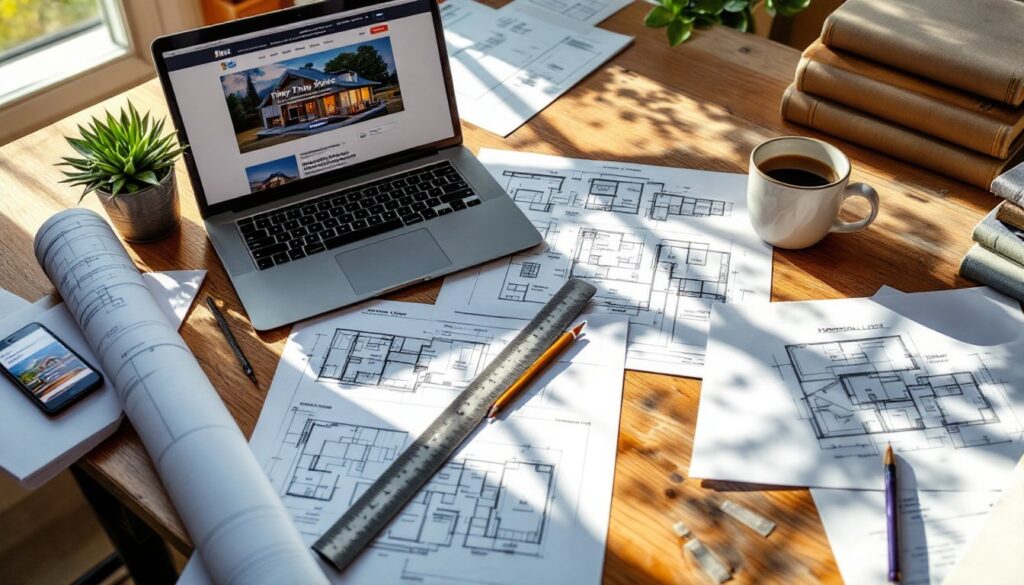
Free plans vary widely in detail. The best packages include floor plans, elevations, cross-sections, and material lists. Floor plans show room dimensions, door swings, and fixture placements. Elevations depict exterior walls from each side, indicating window heights, siding transitions, and roofline pitch (commonly 3/12 to 5/12 for tiny houses).
Cross-sections cut through the structure to reveal wall assembly, insulation layers, and loft framing. Look for callouts specifying R-values (aim for R-13 to R-19 in walls, R-30+ in roofs for four-season use), vapor barriers, and sheathing type (7/16″ or 1/2″ OSB is standard).
Material lists itemize lumber, fasteners, roofing, and trim. Expect nominal sizes, remember a 2×4 actually measures 1.5″ x 3.5″. Fastener schedules indicate nail or screw types and spacing for shear walls and rim joists. Higher-quality free plans include window and door schedules with rough opening dimensions, which are critical when ordering pre-hung units.
What free plans often don’t include: engineered stamped drawings, electrical schematics, plumbing diagrams, or HVAC layouts. You may need to hire a licensed electrician or plumber to design and sign off on those systems, especially if your jurisdiction requires permits. Structural engineering stamps are rare in free plans, which can be a roadblock in areas with strict code enforcement.
Some plans also skip foundation details. If building on a trailer, you’ll need to source a separate trailer spec and understand tongue weight, axle placement, and tie-down anchor points. Permanent foundations (skids, piers, or slabs) require soil analysis and frost depth considerations not typically addressed in generic plans.
Choosing the Right Tiny House Plan for Your Needs
Start by defining use case: full-time residence, guest house, vacation retreat, or rental income? Full-time living demands more storage, a functional kitchen with full-size appliances, and a bathroom layout that doesn’t feel like a camper. Weekend retreats can sacrifice counter space and closet depth for simpler builds.
Square footage dictates layout feasibility. Under 200 sq ft typically means a single loft, compact galley kitchen, and wet bath (shower/toilet combo). 200-300 sq ft opens up ground-floor bedrooms or dual lofts, useful for couples or families. Beyond 300 sq ft, you can fit a separate bedroom, full bathroom, and dining nook without climbing a ladder nightly.
Trailer vs. foundation is the next fork. Trailer-mounted builds must respect road width (8.5 ft max without permits) and height (13.5 ft total for interstate travel). Weight distribution is critical, overloading the tongue or rear axle creates sway and tire blowouts. If going permanent, a skid foundation (pressure-treated 4×6 or 6×6 timbers on gravel) works for level sites with good drainage. Unlevel lots need pier-and-beam or slab foundations, both of which add cost and complexity.
Climate influences insulation, window placement, and HVAC. Cold regions need thicker walls (consider 2×6 framing for R-19 batts), low-E double-pane windows, and airtight construction to prevent ice dams. Hot climates benefit from cross-ventilation, reflective roofing, and minimal west-facing glass. Four-season plans should include a mini-split heat pump or vented propane heater: budget $1,200-$2,500 for the unit plus installation.
Skill level matters. Plans with complex roof intersections, custom cabinetry, or timber framing require intermediate-to-advanced carpentry. If you’ve never framed a wall, start with a rectangular footprint, gable roof, and standard door/window sizes. Save the arched doors and skylights for build number two.
DIY Building vs. Hiring Professionals: Cost Considerations
DIY builds can save 40-60% compared to turnkey tiny houses, but only if you have the time, tools, and troubleshooting skills. Expect 300-600 labor hours for a 200 sq ft shell (framing, sheathing, roofing, windows). Interior finish work, drywall, cabinetry, trim, flooring, adds another 200-400 hours. If you’re working weekends, that’s 6-12 months from trailer to move-in.
Tool investment is non-trivial. Core kit includes a circular saw or miter saw, drill/driver, framing nailer (pneumatic or cordless), level, speed square, tape measure, and sawhorses. Budget $800-$1,500 if starting from scratch. Renting specialty tools (table saw, scaffolding, trailer jack) cuts upfront cost but adds $50-$150 per week.
Material costs for a basic 200 sq ft build run $15,000-$25,000, covering framing lumber, sheathing, roofing (metal or asphalt shingles), siding (T1-11, LP SmartSide, or corrugated metal), insulation, windows, doors, and interior finishes. Prices fluctuate, lumber spiked 300% during the 2021 shortage and has since stabilized but remains above pre-pandemic levels. Factoring in regional variance and material grade (pressure-treated vs. standard framing, vinyl vs. wood windows) is essential.
Hiring pros makes sense for tasks requiring permits or specialized skills. Electricians charge $75-$125/hr and ensure your panel, wiring, and GFCI outlets meet NEC standards. Plumbers ($80-$150/hr) handle supply lines, drain-waste-vent (DWV) systems, and water heater hookups. A general contractor overseeing the entire build typically adds 15-25% to material costs but absorbs liability and code compliance headaches.
Hybrid approaches split the difference: DIYers frame and sheath, then subcontract rough-ins and finish carpentry. This preserves cost savings on the time-intensive grunt work while avoiding costly permit violations or system failures.
Legal and Zoning Requirements You Must Know
Zoning is the first hurdle. Many municipalities classify tiny houses under RVs, accessory dwelling units (ADUs), or manufactured homes, each with different rules. RV classification often prohibits full-time occupancy on residential lots. ADU zoning may allow it but requires a primary dwelling on the same parcel and setback compliance (typically 5-10 ft from property lines).
Some jurisdictions have adopted tiny house appendices to the International Residential Code (IRC), establishing minimum square footage (often waiving the traditional 120 sq ft per room requirement) and allowing lofts with reduced ceiling heights (6 ft 8 in vs. 7 ft). Oregon, California, and Colorado have led adoption: rural counties are generally more lenient than urban centers.
Building permits are required in most areas for structures over 120-200 sq ft or anything with permanent utilities. Permit fees range from $200-$1,500 depending on jurisdiction and project valuation. Inspections typically occur at foundation, framing, rough-in (electrical/plumbing), and final stages. Skipping permits risks stop-work orders, fines, and difficulty selling or insuring the property.
Utility connections add another layer. Connecting to municipal water and sewer requires permits and inspections. Off-grid systems, well water, septic, composting toilets, face county health department review. Electrical service (even a 100-amp subpanel) needs utility company approval and often an engineer’s load calculation.
Trailer-mounted builds skirting building codes must still comply with DMV weight limits, vehicle lighting standards, and road width restrictions. If the house exceeds 8.5 ft wide or 13.5 ft tall, you’ll need oversize load permits for each state you traverse, fees run $50-$200 per permit and require advance routing approval.
Homeowners associations (HOAs) and deed restrictions can outright ban tiny houses regardless of municipal zoning. Review covenants before purchasing land. Insurance is harder to secure for non-traditional builds: specialty RV or tiny house insurers like Strategic Insurance Agency or Tiny Home Insurance Services offer policies, but expect higher premiums than conventional homeowners insurance.