Table of Contents
ToggleBlack roofs have become the go-to choice for homeowners chasing clean lines and contemporary style. But here’s the thing: a black roof can either make your house look like a million bucks or turn it into a visual mismatch if you don’t nail the exterior color pairing. The good news? A black roof is one of the most forgiving roofing choices when it comes to color coordination, it acts as a neutral anchor that plays well with everything from stark whites to moody charcoals. Whether you’re repainting before listing your home or just tired of looking at builder-grade beige, getting the color scheme right is half the battle.
Key Takeaways
- A black roof acts as a versatile neutral anchor that pairs beautifully with white, earth tones, and moody dark color schemes to create modern home exteriors.
- Crisp white or soft off-white siding delivers maximum contrast and creates the clean, contemporary look that modern black roof house color schemes are known for.
- Earth tones like warm taupe, sage, and greige ground dark roof designs while integrating homes naturally into their surroundings, especially in wooded or desert areas.
- Dark siding paired with black roofs creates a high-end monolithic effect but requires meticulous surface prep and heat-resistant paint formulations to prevent failure.
- Accent colors on doors, shutters, trim, and hardware should be intentionally coordinated with your main color choice to create visual cohesion rather than visual clutter.
- Always test paint colors on large poster boards at different times of day before committing, as morning light, midday sun, and evening shade dramatically shift how colors appear on your home.
Why Black Roofs Are Dominating Modern Architecture
Black roofs aren’t just trendy, they’re practical. Asphalt shingles in black or dark gray tones remain the most affordable roofing material in North America, typically running $90–$150 per square (100 sq ft) installed, depending on your region and shingle grade. But the shift toward black goes beyond budget.
Modern and contemporary home designs favor bold contrast and geometric simplicity. A black roof delivers both. It frames the house, drawing the eye to horizontal siding lines, large windows, and intentional landscaping. Architecturally, it mimics the effect of a picture frame: neutral, grounding, and designed to make everything else pop.
From a performance standpoint, darker roofs absorb more heat, useful in northern climates where you want passive solar gain in winter, less ideal in Phoenix in July. If you’re in a hot climate, look for cool-roof rated shingles with reflective granules that meet Energy Star standards. These products use infrared-reflective pigments to reduce heat absorption by up to 20%, even in black tones.
Black also hides dirt, algae staining, and minor weathering better than lighter roofs. In humid regions prone to Gloeocapsa magma (the black algae streaks you see on aging roofs), starting with a dark color means those streaks blend in rather than announce themselves from the street.
Best Exterior Paint Colors to Pair with Black Roofs
Crisp White and Light Neutrals
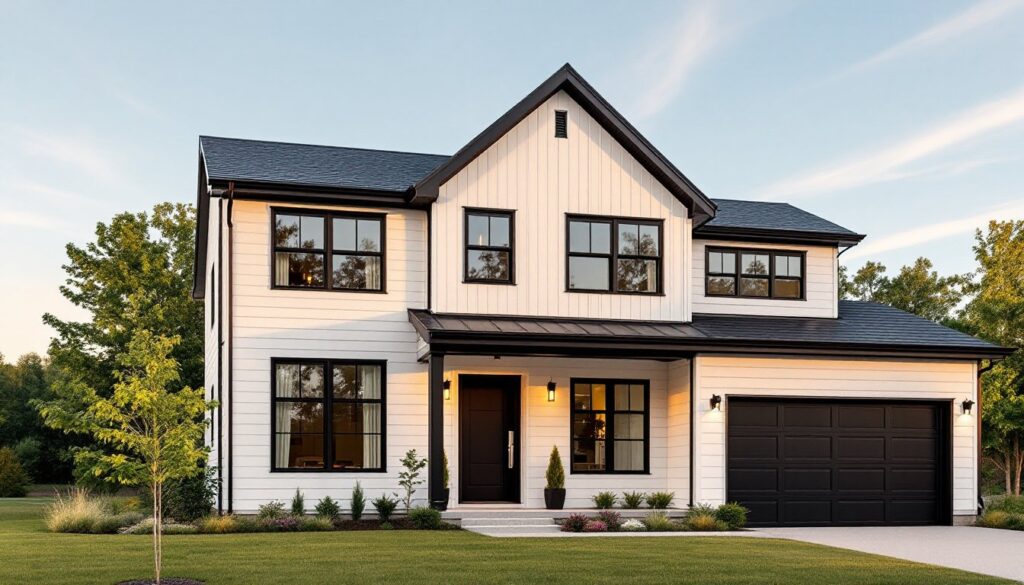
Nothing beats the high-contrast punch of a pure white or soft off-white exterior under a black roof. This is the classic modern farmhouse look, and it works because the palette is intentionally minimal. For exteriors, use 100% acrylic latex exterior paint, it flexes with temperature swings and resists cracking better than oil-based coatings.
Popular white and light neutral shades include Benjamin Moore’s Swiss Coffee (a warm white with subtle yellow undertones), Sherwin-Williams Alabaster (a soft white that doesn’t read stark), and Accessible Beige for homeowners who want warmth without going tan. These colors reflect sunlight, keeping siding cooler and reducing the visual weight of the roofline.
One gallon of quality exterior paint covers roughly 250–400 square feet depending on siding texture (smooth fiber cement vs. rough-sawn wood). Budget two coats minimum for even coverage, especially when going from a darker existing color to white.
Pro tip: If you’re painting fiber cement siding (like HardiePlank), use a paint specifically formulated for cementitious surfaces. These paints have better adhesion and flexibility to handle the substrate’s expansion and contraction.
Warm Earth Tones and Natural Palettes
Earth tones bring a grounded, organic feel that pairs beautifully with black roofs, think warm taupe, soft sage, muted terracotta, and greige (gray-beige hybrids). These shades integrate homes into natural surroundings, especially in wooded or desert settings.
Sherwin-Williams Accessible Beige, Repose Gray, and Roycroft Pewter are reliable mid-tone neutrals. For those looking at deeper warmth, Benjamin Moore’s Copley Gray or Weimaraner deliver sophisticated brown-grays that avoid the 1990s tan trap.
When working with earth tones, pay attention to your home’s fixed elements, brick, stone veneer, or stucco accents. If you have warm-toned brick, choose a siding color with similar undertones. Cool gray brick pairs better with cooler grays or whites.
Don’t skip the sample step. Buy quart-sized testers and paint 2×2-foot poster boards (not directly on your siding). Prop them against the house and observe them at different times of day. Morning light, midday sun, and evening shade all shift color temperature.
Bold Dark and Moody Combinations
For homeowners who want drama, pairing a black roof with a dark charcoal, navy blue, forest green, or even black siding creates a cohesive, high-end look. This approach is all over contemporary modern design portfolios and works especially well on homes with clean lines, minimal ornamentation, and high-quality materials.
Sherwin-Williams Iron Ore, Benjamin Moore Kendall Charcoal, and Sherwin-Williams Naval are go-to deep tones. These colors work because they eliminate contrast between roof and siding, creating a monolithic, sculptural effect. The home reads as one solid form rather than a collection of parts.
Here’s the catch: dark exteriors show imperfections. Surface prep is non-negotiable. Power wash at 1,500–2,000 PSI (not more, you’ll damage siding), scrape loose paint, fill holes with exterior-grade wood filler or caulk, then prime with a stain-blocking primer like Zinsser Cover Stain or Kilz Premium. Dark colors amplify any unevenness in the substrate.
Dark siding also absorbs heat, which can lead to paint failure if you choose the wrong product. Look for paints with a Light Reflectance Value (LRV) above 5 if you’re going charcoal or navy. Some manufacturers (like Benjamin Moore’s Aura line) specifically engineer darker colors to handle heat stress.
How to Choose Accent Colors and Trim for Your Black Roof Home
Once you’ve nailed down your main siding color, trim and accents are where personality shows up. Trim (fascia, soffits, window casings, door frames) typically gets painted in a contrasting or complementary shade. For a crisp, traditional look, white trim on any body color is a safe bet. For a more modern vibe, consider matching the trim to the body color for a seamless, monolithic appearance.
If your siding is white or light neutral, try a bold front door: matte black, deep charcoal, forest green, burnt orange, or even mustard yellow. A gallon of exterior door paint covers roughly 400 square feet, so a single quart is usually enough for a standard entry door with one or two coats.
Shutters, garage doors, and accent panels offer another opportunity for contrast. Pairing white siding with black shutters and a black garage door reinforces the roof’s color and creates visual rhythm. If your siding is dark, lighter or metallic accents (brushed nickel hardware, light gray garage doors) prevent the exterior from feeling too heavy.
For homeowners eyeing resale value, research shows neutral palettes tend to appeal to the widest buyer pool, with strategic exterior paint colors often boosting perceived value. But don’t be afraid to inject character, just keep loud colors limited to easily repaintable areas like doors and shutters.
Hardware and fixtures matter more than most DIYers think. Matte black or oil-rubbed bronze light fixtures, house numbers, and mailboxes reinforce a cohesive black roof house color scheme. Avoid mixing metal finishes, if your door hardware is black, keep porch lights and house numbers black too.
One often-overlooked detail: gutter color. Most homeowners default to white, but black or dark bronze gutters and downspouts can visually extend the roofline and create a more integrated look, especially on homes with dark siding. Seamless aluminum gutters can be custom-fabricated in nearly any color for about $8–$12 per linear foot installed.
Safety note: If you’re painting exterior trim or siding above ground level, use a stabilized extension ladder rated for your weight plus materials (typically a Type I or Type IA ladder with a 250–300 lb. capacity). Secure the ladder’s feet and have a second person nearby if you’re working above 10 feet. For two-story homes, consider renting scaffolding or hiring a pro, most painting-related injuries happen on ladders.
Conclusion
A black roof gives you a versatile foundation to build a standout exterior color scheme. Whether you go high-contrast with white, grounded with earth tones, or bold with dark moody hues, the key is intentional coordination between siding, trim, and accents. Take the time to test samples, prep surfaces properly, and choose quality exterior paint formulated for your climate and substrate. Done right, a well-planned black roof house color scheme doesn’t just boost curb appeal, it makes your home feel cohesive, modern, and thought-through from the street.