Table of Contents
ToggleThe housing market’s gotten tight, and folks are looking for alternatives that don’t compromise quality or livability. Enter the foldable tiny house, a clever solution that combines portability with functionality. These collapsible dwellings aren’t glorified sheds: they’re engineered structures that expand from compact shipping dimensions into livable spaces, complete with utilities and real insulation. Whether you’re considering a backyard ADU, a remote getaway, or a semi-permanent living situation, understanding how these units work and what they cost will help you decide if this approach fits your needs. Let’s break down what makes these folding tiny house structures worth a closer look.
Key Takeaways
- A foldable tiny house is a prefabricated, collapsible structure that deploys from a compact 8×20-40 foot folded state into a full residential space with insulation, utilities, and proper framing within hours.
- Foldable tiny houses offer significant portability advantages, fitting within standard DOT width limits and avoiding special transport permits, while reducing setup time to days compared to months for traditional construction.
- Total costs range from $40,000 for entry-level models to $130,000+ for automated units, with additional expenses for delivery ($5,000–$10,000), site prep ($3,000–$6,000), and utility connections ($1,500–$20,000) depending on location.
- These portable units use hinged frame systems with hydraulic or manual deployment mechanisms and rely on reinforced hinges, weather-resistant seals, and R-13 to R-30+ insulation to ensure durability and weatherproofing.
- Foldable tiny houses work as ADUs, guest houses, and temporary housing solutions, though zoning classification varies by jurisdiction—check local codes before purchasing, as some areas treat them as RVs while others require full building permits.
- Proper installation demands a level foundation, secure anchoring in wind-prone areas, licensed professionals for electrical and plumbing work, and thorough inspection of seals and connections before utility hookup.
What Is a Foldable Tiny House?
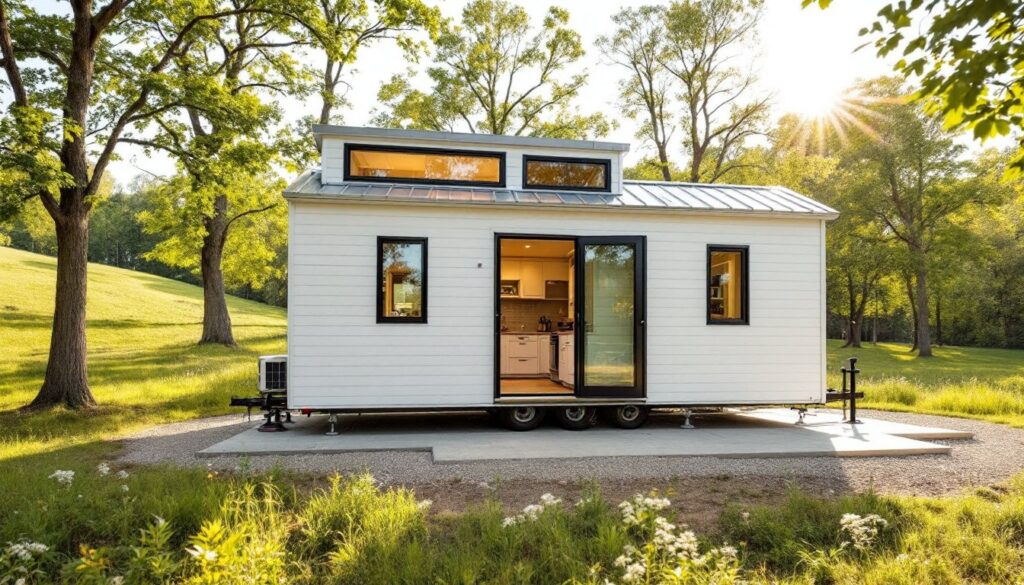
A foldable tiny house is a prefabricated structure designed to collapse into a compact footprint for transport, then expand on-site into a full living space. Think of it like a pop-up camper, but built to residential standards with proper framing, insulation, and utilities.
Most units ship on a flatbed trailer in a folded state, typically 8 feet wide by 20-40 feet long by 8-10 feet tall. Once delivered, hydraulic jacks, manual cranks, or electric motors unfold walls and roof sections. The entire deployment takes anywhere from 30 minutes to a few hours, depending on the model and whether you’re connecting utilities.
These aren’t tents with better marketing. Structural components include steel or aluminum frames, SIPs (structural insulated panels) for walls, and composite or metal roofing. Interior finishes range from basic plywood to full drywall with trim. Electrical runs through conduit embedded in panels, and plumbing is pre-routed with quick-connect fittings.
The key difference from traditional tiny houses on wheels is the collapsibility. Standard tiny houses are permanently built on trailers: foldable models prioritize compactness during transit, which means they can navigate tighter roads and don’t require wide-load permits in most states.
Key Benefits of Choosing a Foldable Tiny House
Portability is the headline feature. A folded unit fits within standard DOT width limits (under 8.5 feet), so you can relocate without special permits or pilot cars. This matters if you’re moving between properties or testing different locations before committing.
Faster setup beats stick-built construction by months. Once the foundation or piers are ready, unfolding and connecting utilities happens in a day or two. No framing schedule, no weather delays, no subcontractor coordination.
Lower transportation costs compared to traditional tiny houses. Because the profile is compact, you’re not paying for oversize load escorts. Some owners tow their own units with a heavy-duty pickup: others hire local equipment movers.
Versatility is another win. These units work as ADUs (accessory dwelling units), guest houses, home offices, or temporary housing during renovations. Many folks experiment with layouts inspired by small space living ideas to maximize every square foot. Because they’re not permanently anchored, they often fall into different zoning categories than traditional structures, check local ordinances, but many jurisdictions treat them more like RVs or mobile homes.
Reduced material waste during manufacturing. Factory-built components are cut to exact specs, and leftover materials get reused across production runs. That’s not just environmental, it translates to tighter tolerances and better fit during assembly.
How Foldable Tiny Houses Work: Design and Mechanics
The core principle is a hinged frame system. Imagine a box where the walls fold inward onto the floor. When deployed, those walls swing upward and lock into place with pins, latches, or hydraulic struts.
Hydraulic systems are common on higher-end models. Integrated cylinders push walls and roof sections into position at the flip of a switch. You’ll need a 12V power source (usually a marine battery or generator) to run the pump. Once extended, mechanical locks engage to hold everything rigid.
Manual systems use telescoping poles or hand-crank winches. They’re cheaper and less prone to failure, but you’ll need two people and about an hour of labor. Some designs use gas struts (like tailgate lifts) to assist the process.
Roof deployment varies. Flat or low-slope roofs simply hinge up with the walls. Gable or shed roofs often telescope or slide into place after walls are locked. Weatherproofing relies on EPDM rubber gaskets or compression seals at joints, similar to what’s used in shipping containers or mobile command centers.
Utility connections are standardized. Electrical panels mount near the entry, usually wired for 120V/30A or 50A service (same as RV hookups). Plumbing inlets use RV-style quick-connects for water supply, and waste lines route to a holding tank or standard sewer connection. HVAC is typically a mini-split system or rooftop unit, pre-charged and ready to plug in.
Insulation is critical in a folding design. Most manufacturers use R-13 to R-21 panels in walls and R-30+ in the roof. That’s on par with standard residential construction. Joints and hinges get foam tape or magnetic seals to prevent air leaks.
One thing to watch: hinge points are potential weak spots. Quality units reinforce these with steel brackets and weather-resistant coatings. Ask manufacturers about corrosion protection and hinge cycle ratings, good hardware should handle hundreds of deploy/fold cycles.
Popular Foldable Tiny House Models and Styles
Several manufacturers dominate this niche, each with distinct approaches.
Boxabl offers the Casita model, a 375-square-foot unit that ships in a folded module. It’s a full-height space with 9.6-foot ceilings, a separate bedroom, bathroom, and kitchen. Setup is hydraulic, and the design meets IRC (International Residential Code) standards in many jurisdictions. Price hovers around $60,000 before delivery.
MODS International builds expandable containers. Their units start as 20-foot shipping containers, then side walls slide out to double the interior width. Floor plans include studio, one-bedroom, and even two-bedroom layouts. Finishes are industrial-chic: exposed steel, luxury vinyl plank floors, quartz counters. Expect $50,000–$80,000 depending on specs.
Ten Fold Engineering takes a different route with fully automated deployment in under 10 minutes. Their models are commercial-grade, think disaster relief or remote work camps, but residential versions are available. These are high-end: $130,000+.
Portable Living Structures (PLuS) focuses on lightweight aluminum frames and canvas-composite panels. Their units fold to trailer size and weigh under 5,000 pounds, so mid-size trucks can tow them. Interiors are minimalist but functional. Around $40,000 for base models.
For the hands-on crowd, companies like Instructables host DIY plans for building your own folding tiny house using modified shipping containers or custom steel frames. Budget $15,000–$25,000 in materials if you’re doing the labor yourself, but plan on several months of evenings and weekends.
Cost Considerations: What to Expect When Buying or Building
Base unit pricing ranges from $40,000 for entry-level models to $130,000+ for fully automated luxury versions. That’s just the structure, factor in delivery, setup, and site prep.
Delivery costs depend on distance and accessibility. Expect $2–$5 per mile for professional transport. A cross-country haul can add $5,000–$10,000. If your site requires a crane to lift the unit off the trailer, add another $1,500–$3,000.
Site preparation is often underestimated. You’ll need a level foundation, either a concrete slab, pier-and-beam setup, or heavy-duty trailer pads. A 4-inch concrete slab for a 20×40-foot unit runs $3,000–$6,000 depending on your region. Pier systems (using concrete footings and steel beams) cost $2,000–$4,000 but work better on sloped or uneven ground.
Utility hookups vary widely. If you’re close to existing services, running electrical (200A panel, permits, trenching) might be $1,500–$3,000. Adding septic or well systems in remote areas can hit $10,000–$20,000. Always get a licensed electrician and plumber for final connections, DIY is fine for interior work, but service entries typically require permits and inspections.
Permits and fees are location-dependent. Some counties treat foldable units as RVs (minimal permitting), others as permanent structures (full building permits required). Budget $500–$2,000 for permit fees and inspections. If your jurisdiction requires an engineer’s stamp on the foundation plan, add $800–$1,500.
Insurance is trickier. Standard homeowners policies may not cover a foldable unit. You might need RV insurance, mobile home coverage, or a specialized tiny house policy. Expect $600–$1,200 annually.
Financing options are limited. Traditional mortgages usually don’t apply: look into personal loans, RV loans, or manufacturer financing. Interest rates run higher than conventional mortgages, 6%–10% as of 2026.
Setting Up Your Foldable Tiny House: Installation and Placement Tips
Pick your site carefully. You need level ground, drainage away from the structure, and access for a flatbed trailer. Measure twice, most units are 8 feet wide folded but expand to 16-24 feet wide deployed. Confirm setback requirements with your local planning department: many areas require structures to be at least 5-10 feet from property lines.
Foundation prep is critical. Even if you’re placing the unit on piers, the ground must be compacted and stable. Use a laser level to check grade, anything over 2 inches of slope across the footprint will cause problems. For concrete slabs, embed anchor bolts or use hurricane ties to secure the frame. In wind-prone areas, this isn’t optional: it’s required by code.
Deployment day: Have at least two people on hand, even for hydraulic systems. You’ll need to guide panels as they unfold and check that locks engage fully. Wear work gloves, safety glasses, and steel-toe boots, pinch points are real.
Once extended, walk the perimeter and inspect all seals. Run a hose over joints to test for leaks before connecting utilities. Address any gaps with butyl tape or silicone caulk rated for outdoor use.
Electrical connection: If your unit uses a 30A or 50A RV-style inlet, you can wire it to a dedicated circuit breaker in your main panel. Use 10 AWG copper for 30A or 6 AWG for 50A, and route through weatherproof conduit. If you’re powering via a subpanel, follow NEC (National Electrical Code) requirements for wire gauge and breaker sizing. This is a job for a licensed electrician unless you’re confident pulling permits and scheduling inspections yourself. Applying creative hacks to interior layout is fine, but electrical work demands code compliance.
Plumbing hookup: Connect the water inlet to your supply line using a pressure regulator (set to 40-50 PSI) to prevent damage to interior fixtures. Route wastewater to a sewer connection or holding tank. If using a septic system, confirm the unit’s greywater and blackwater volumes are within system capacity.
HVAC startup: Mini-split systems need a 220V circuit and should be installed by an HVAC tech if not pre-charged. For rooftop units, check that ductwork seals are tight and filters are installed.
Final checks: Test all outlets, plumbing fixtures, and appliances. Adjust door latches and window locks, frame settling during deployment can throw alignment off slightly. Re-torque anchor bolts after 24 hours.
Conclusion
Foldable tiny houses offer a practical middle ground between portability and permanence. They’re not for everyone, site prep, permits, and utility connections require the same attention as any building project. But if you need flexible housing that can adapt to changing circumstances, a folding tiny house delivers efficiency without sacrificing livability. Do the legwork upfront: verify local codes, budget realistically for the full installation, and choose a manufacturer with a solid track record. Get the details right, and you’ll have a space-efficient structure that works as hard as you do.